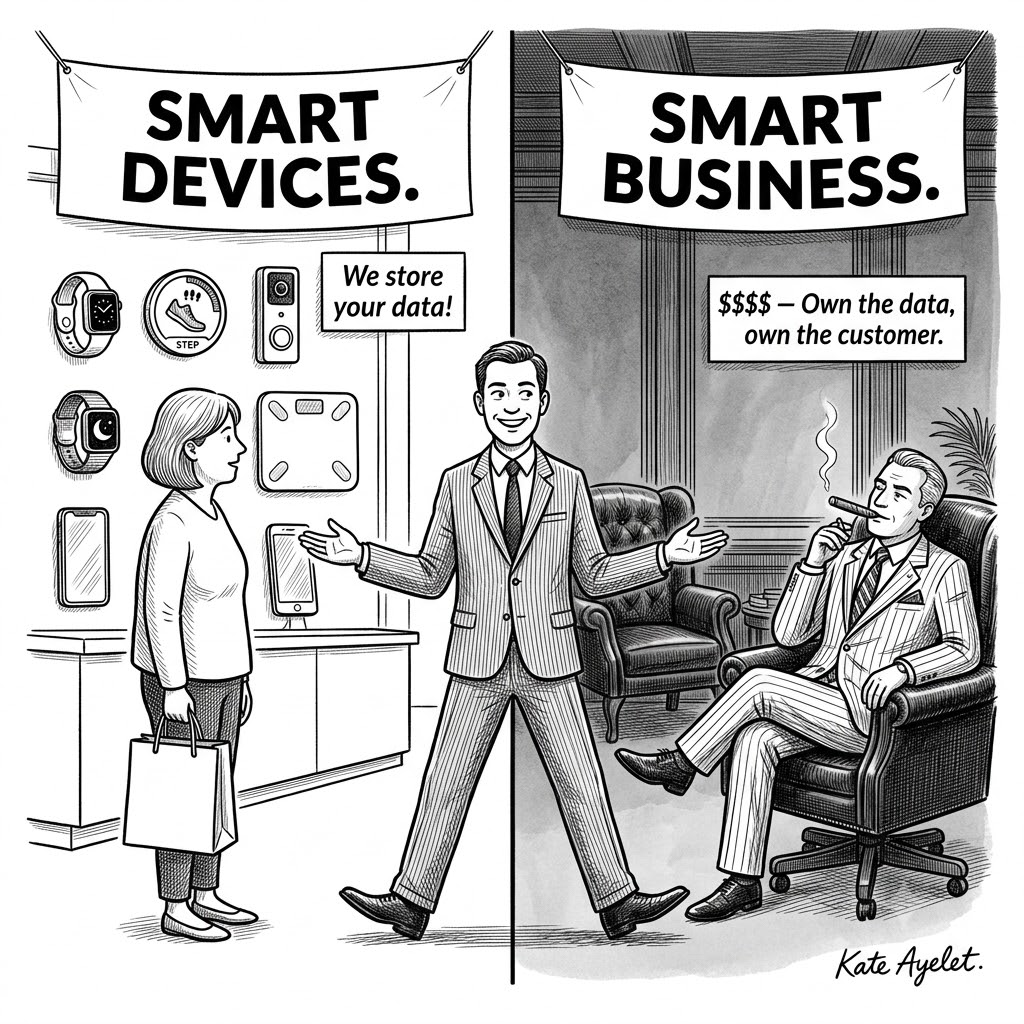
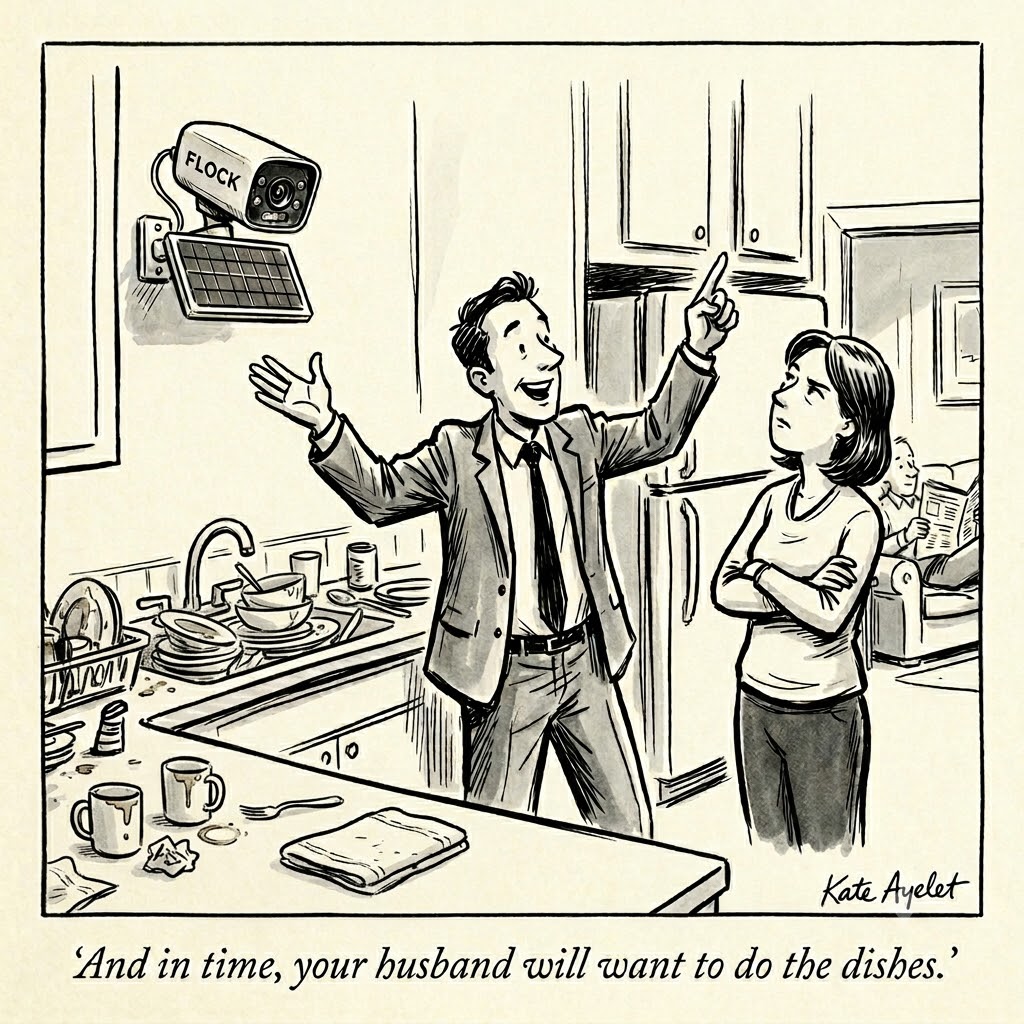
It turns your comings and goings into data. And data is robot money.
The machine watches. Eyes Off is what we tell it.
What one search looks like from the inside. No warrant, no judge, 83,345 cameras, to find someone who did nothing. [404 Media · EFF]
In 2026, Flock deleted the clause promising it would never sell your data, and granted itself a perpetual license to keep using it, even after a town cancels. It now plugs into commercial data brokers to jump from your plate to your name.
Appetite: every passing car. Memory: months, by default. Friends: 5,000+ agencies. Paid for by: you. "I remember every car. I don't remember your rights."
Watch the whole stack fire on one person, from a sound on the street to a full dossier, in under a minute. It works just as smoothly on you.
Little cars, normal errands, and a log that never stops growing. Nobody did anything wrong. That is the point.
The Ark fought two records denials, read 576,000 search logs, and found 16,029 searches the police audit missed. Local journalism did this.
The cameras are a contract, and contracts end. Write to the people who sign it, get counted, and bring two neighbors.
Cameras on poles that watch every car. Here is what they do:
Kept for months. Shared between thousands of agencies.
Flock began in 2017 as a solar camera for HOA package thefts. It is now an integrated surveillance operating system: plate readers, gunshot mics upgraded to listen for "human distress," AI search that finds people by description, drone-as-first-responder fleets that read plates mid-air, and a data-fusion platform, Flock Nova, that joins plates to phones, faces, jail records, and public data into a single dossier.
Type "blue SUV with a ladder", or a person's description, and search every owned and shared camera. People-tracking, not labeled facial recognition.
[src: Flock Q2 2025 launch]Fuses plate data with RMS, CAD, jail records, OSINT and public records. The EFF called it a "dystopian panopticon."
[src: EFF, 2025]$300M acquisition. Rooftop auto-launch, 86-second response, in-flight plate reading, autonomous vehicle-follow.
[src: TechCrunch, 2024]Want to see it move? Watch the whole stack fire on one person, acoustic alert to full dossier, in under a minute. Step inside the Real-Time Crime Center →
Here is the part the procurement pitch leaves out: the independent evidence that mass plate readers reduce or prevent crime is thin and mixed. They are adopted far faster than they are evaluated.
We don't claim it never helps. We claim the public was sold prevention, the evidence shows at best narrow recovery, and the cost, below, is enormous and documented.
One officer, one text box, no warrant. Flock's own logs are the proof.
Continuous spatial tracking without a judge's signature, an end-run around the Fourth Amendment and the Carpenter and Jones rulings.
Your plate, phone token, ad ID and location history are joined across permanent keys. You can't opt out of physical infrastructure, so your identity is conscripted. This is what Flock Nova does today.
Once movement data is for sale, inferred risk can quietly gate insurance, credit, and access, with no transparent criteria and no appeal. The brokers and the pipes already exist.
When one un-auditable system can both watch what you do and shape the choices put in front of you, the line between observation and influence thins.
Deployed plate readers back in 2010, switched to Flock last summer, and added downtown cameras, expanding while neighbors pulled back.
[src: The Ark]Cut off all outside-agency access except six Marin agencies, one day after The Ark's investigation published. Exposure produces rollback fast.
[src: The Ark, Feb 2026]More than 1,000 federally entangled searches by eight agencies in a single month before access was restricted.
[src: Marin / California Playbook]And the tide is turning: 30+ cities have cancelled or deactivated Flock since January 2025: Austin, Cambridge, Santa Cruz, Evanston, Flagstaff. Senator Wyden has asked the FTC to investigate. San Jose faces lawsuits over 3,965,519 warrantless searches in a year. [src: NPR; EFF; IJ; Krishnamoorthi/Wyden to FTC]
The argument bypasses politics when it's drawn. Single-panel, New Yorker-style, because the absurdity is the point.


When we stop watching out for each other, we hire robots. The robots turn what they see into data, and data is robot money.
If we watch out for each other again, we don't need a machine watching us. Eyes off.
We don't argue ethics in the abstract. We use the statutes that already exist, while the window is open, before the Flock IPO hardens the business in mid-2027.
If a network captures your data, you get to log in and audit who queried it and where it was routed. Vendors who can't support resident-level reverse auditing become non-compliant, and defundable.
A one-click engine to file free, legally binding deletion requests under California's Delete Act, draining the broker pools that make population-scale tracking feasible.
Rolling public-records requests every 60 days to pull search-justification logs and sharing agreements, compiled into a formal SB 34 compliance brief.
Sequential Burma-Shave signs along Tiburon Boulevard and the comic series in downtown cafes. The disarming surface that drives people here.
When a camera goes up or sharing expands, you hear it first. Pitch in as much or as little as you want.